
Silkron FAQ: Ingredients, Safety, Side Effects & Product Information
This FAQ brings together the key facts from the official Silkron 10g packaging and package insert, including prescription status, active ingredients, labeled indication scope, contraindications, precautions, possible adverse effects, storage and manufacturer information.
What should you know about Silkron?
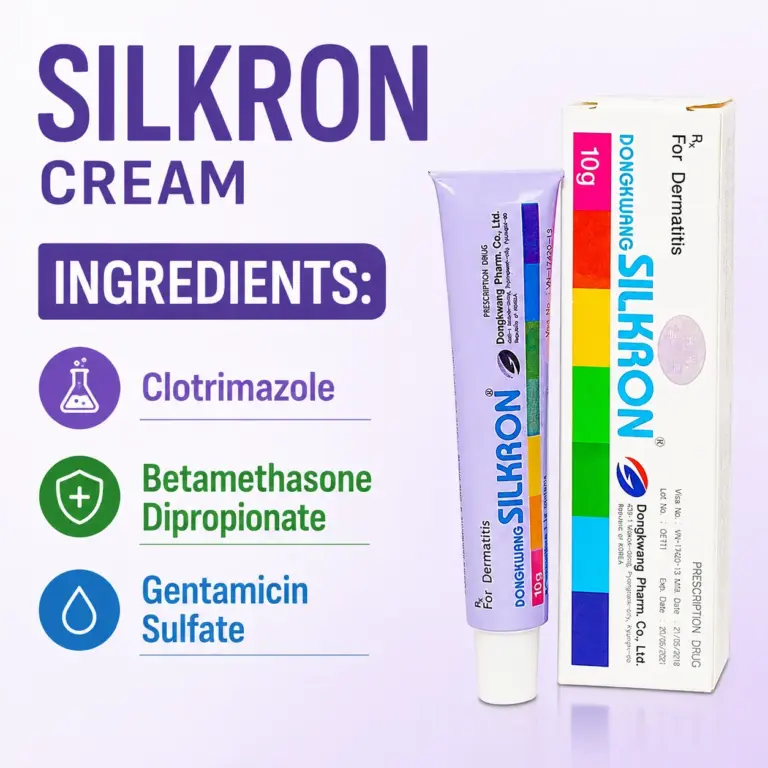
Silkron is a prescription topical cream containing clotrimazole, betamethasone dipropionate and gentamicin sulfate. Because it combines an antifungal, a corticosteroid and an aminoglycoside antibiotic, its official insert contains both medicine-specific indications and important safety restrictions.
This page is designed as a question-and-answer overview. Detailed topics such as ingredients, contraindications and adverse effects are kept in separate cluster articles so the FAQ can stay concise while still linking to the deeper information.
General Silkron Questions
These answers summarize the basic product identity shown on the supplied Silkron packaging and package insert.
Silkron is a topical skin cream containing an antifungal, a corticosteroid and an aminoglycoside antibiotic. The supplied packaging identifies it as a prescription medicine for external use.
Yes. The supplied Silkron box and product information identify the cream as a prescription medicine.
Yes. The supplied packaging identifies Silkron as a topical medicine for external use.
The supplied Silkron package contains one 10g tube.
The official product information describes Silkron as a white to off-white cream.
What Is in Silkron Cream?
The amounts below reproduce the active composition printed on the supplied 10g Silkron packaging.
| Clotrimazole | 100 mg per 10g |
|---|---|
| Betamethasone dipropionate | 6.4 mg per 10g |
| Gentamicin sulfate | 10 mg potency per 10g |
Silkron contains clotrimazole, betamethasone dipropionate and gentamicin sulfate. The Silkron Ingredients guide covers the formula in more detail.
Yes. Betamethasone dipropionate is the corticosteroid component in the Silkron formula.
Yes. The insert identifies clotrimazole as an imidazole antifungal component.
Yes. Gentamicin sulfate is the aminoglycoside antibiotic component listed in the official formula.
Yes. The supplied insert also lists excipients including cetanol, stearyl alcohol, liquid paraffin, polysorbate 60, sorbitan monostearate, propylene glycol, citric acid hydrate, disodium edetate hydrate, methyl paraben, propyl-paraben and purified water.
What Conditions Are Listed in the Silkron Information?
The official materials describe a specific prescription indication scope. The list should not be interpreted as a self-diagnosis checklist.
The supplied Vietnamese insert describes bacterial or fungal infection and corticosteroid-responsive skin diseases associated with infection. Examples printed in the insert include allergic dermatitis, contact dermatitis, atopic dermatitis, seborrheic dermatitis, eczema, intertrigo or diaper-type rash, exfoliative dermatitis and chronic lichen simplex.
The English outer box additionally lists several fungal skin conditions. The dedicated Silkron Uses guide preserves that official indication wording in context.
No. The package insert contains specific contraindications, and some conditions in that contraindication list can resemble other rashes or infections. Silkron's prescription status and the diagnosis behind its use are therefore important.
Yes. The supplied English outer box lists fungal conditions including forms of tinea, pityriasis versicolor and skin candidiasis.
Silkron Safety Questions
The supplied insert contains a detailed safety section. The answers below summarize the main categories and point to the dedicated safety guide.
The official insert lists wounds and mucous membranes among the contraindications.
Acne vulgaris and rosacea are specifically listed among the contraindications in the supplied insert. Perioral dermatitis is also listed.
Silkron contains betamethasone dipropionate. The insert states that topical corticosteroids can be absorbed systemically and discusses reversible HPA-axis suppression and other systemic corticosteroid effects in some patients.
The insert warns that prolonged treatment, particularly under occlusive conditions, can increase the relevance of systemic corticosteroid-like adverse effects.
Yes. Silkron contains gentamicin sulfate, an aminoglycoside. The insert includes precautions concerning concurrent systemic aminoglycoside exposure and lists hypersensitivity to aminoglycoside antibiotics among the contraindications.
The supplied insert states that compatibility studies are not available and says Silkron should not be mixed with other medicines.
For the complete contraindication list
See Silkron Safety & Precautions for the full label-based discussion of contraindications, corticosteroid precautions, aminoglycoside warnings, pregnancy, breastfeeding, interactions and overdose information.
Silkron Side Effects Questions
The package insert lists local skin reactions as well as steroid-related and systemic or organ-related effects. It does not give one frequency classification for the entire list.
The supplied insert lists reactions including irritation, stinging, burning, rash, erythema or redness, a warm or flushing sensation, itching, dry skin, folliculitis, boils, purulent dermatitis and allergic contact dermatitis.
Yes. The insert includes steroid-related pustules, steroid acne, perioral dermatitis, ichthyosis-like or scaly changes, hypertrichosis and hyperpigmentation.
Yes. HPA-axis suppression, renal impairment and reduced hearing also appear in the official adverse-effect information.
The supplied insert does not provide one frequency category for every adverse effect. It would therefore be inaccurate to treat the whole list as equally likely.
The Silkron Side Effects guide organizes the reactions from the supplied insert into local, infection-related, steroid-related and systemic categories.
Pregnancy, Breastfeeding & Children
The supplied insert states that safety in pregnant women has not been established and says Silkron should not be used in pregnant women or women who may become pregnant.
The insert states that it is unknown whether topically applied corticosteroids are excreted into breast milk and advises caution in breastfeeding women.
Yes. The insert calls for particular caution in neonates and children in connection with prolonged use and aminoglycoside-related toxicity concerns.
Storage, Shelf Life & Manufacturer
| Manufacturer | Dong Kwang Pharm Co., Ltd. |
|---|---|
| Manufacturing address | 115 Sandan-ro, Pyeongtaek-si, Gyeonggi-do, Korea |
| Country | South Korea |
| Pack size | 1 tube × 10g |
| Shelf life | 36 months from the manufacturing date |
| Storage | Keep tightly closed in a dry place, protected from light, at a temperature not above 30°C. |
The supplied packaging identifies Dong Kwang Pharm Co., Ltd. as the manufacturer. For company background, see Dongkwang Pharmaceutical: The Korean Manufacturer Behind Silkron .
The official product information gives the manufacturer address as 115 Sandan-ro, Pyeongtaek-si, Gyeonggi-do, Korea.
The supplied product information says to keep the medicine tightly closed in a dry place, protected from light, at a temperature not above 30°C and out of the reach of children.
The supplied product information states a shelf life of 36 months from the manufacturing date.
Use the FAQ as an overview, not as a substitute for the current insert
This FAQ summarizes the supplied Silkron packaging and package insert. The dedicated safety and side-effects articles provide more detail where the official information is extensive.
- Silkron is identified as a prescription topical medicine.
- The official insert contains specific contraindications.
- The corticosteroid component has additional precautions.
- The adverse-effect list includes both local and systemic effects.
- Always refer to the current package insert supplied with the medicine.
Choose the Silkron topic you need
For the formula, continue to Silkron Ingredients . For contraindications and warnings, use Silkron Safety & Precautions . For adverse reactions, see Silkron Side Effects . The complete Silkron guide serves as the central navigation page for the topic.