
Silkron Side Effects: Possible Skin Reactions & Safety Advice
The official Silkron package insert lists a range of possible adverse effects involving the skin, infection-related reactions, corticosteroid-related changes and several systemic or organ-related effects. This guide organizes those reactions by category without assigning frequencies that are not stated in the supplied insert.
What side effects are listed for Silkron?
The Silkron package insert lists possible local skin reactions such as irritation, stinging, burning, rash, redness, itching and dry skin. It also lists several steroid-related skin changes, infection-related reactions and systemic or organ-related adverse effects.
The supplied insert does not provide a frequency classification for every reaction. For that reason, this guide does not label the entire list as “common,” “rare” or “serious” unless the source itself provides that distinction.
Skin reactions listed in the Silkron insert
A substantial portion of the adverse-effect list involves the treated skin itself. The official insert lists the following local reactions.
Irritation and discomfort
- Skin irritation
- Stinging
- Burning sensation
- Flushing or warm sensation
- Itching
Visible skin changes
- Rash
- Erythema or redness
- Dry skin
- Sweating
- Worsening of existing lesions
Inflammatory reactions
- Folliculitis
- Boils
- Purulent dermatitis
- Allergic contact dermatitis
Other local effects
- Ulceration
- Worsening skin lesions
The insert does not give one frequency for this entire list
This guide therefore does not describe all of these reactions as equally likely. It reproduces and organizes the adverse effects stated in the supplied Silkron product information.
Viral or bacterial infection is also listed
The Silkron package insert lists viral or bacterial infection among the possible adverse effects, particularly in connection with occlusive dressings.
This point is important because Silkron already contains an antibiotic, an antifungal and a corticosteroid. The presence of antimicrobial ingredients does not mean that secondary or worsening infection cannot occur.
Steroid-related skin changes listed in the insert
Because Silkron contains betamethasone dipropionate, the official adverse-effect section also lists several corticosteroid-related skin reactions.
Steroid acne and pustules
The adverse-effect list includes steroid-related pustules and steroid acne.
Perioral dermatitis
Perioral dermatitis appears in the adverse-effect section and is also listed among the contraindications elsewhere in the Silkron insert.
Scaly or ichthyosis-like changes
The insert lists ichthyosis-like or scaly skin changes among the steroid-related reactions.
Hair and pigmentation changes
Hypertrichosis and hyperpigmentation are also listed in the official adverse-effect information.
Why the betamethasone component matters
These reactions help explain why the corticosteroid component is more than an ingredient-name difference. Betamethasone also shapes Silkron's contraindications and precautions.
For the role of each active ingredient, see the Silkron Ingredients guide .
The insert also lists effects beyond the application site
Not every adverse effect listed for Silkron is limited to the skin. The official insert also includes the following systemic or organ-related effects.
- Hypothalamic-pituitary-adrenal (HPA) axis suppression.
- Renal impairment.
- Reduced hearing.
The safety section of the same package insert explains that topically applied corticosteroids can be absorbed systemically and that large treatment areas, damaged skin and occlusion can make absorption more relevant.
The insert also contains precautions concerning gentamicin and concurrent systemic aminoglycoside exposure.
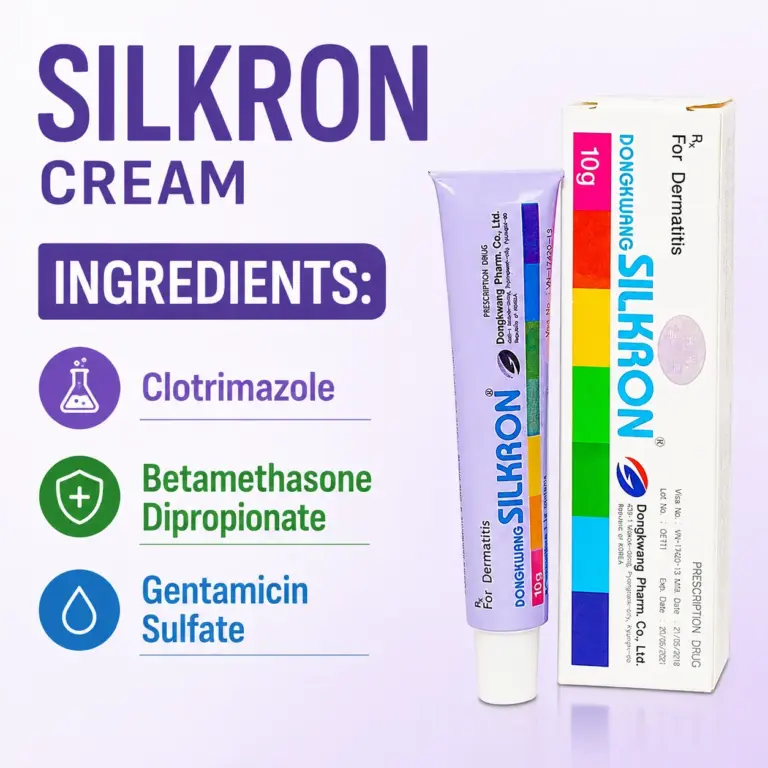
Why Silkron's three active ingredients matter to the side-effect profile
Clotrimazole
Clotrimazole is the imidazole antifungal component of Silkron.
Betamethasone dipropionate
This topical glucocorticoid explains the steroid-specific skin effects and systemic corticosteroid precautions found in the insert.
Gentamicin sulfate
Gentamicin is the aminoglycoside antibiotic component. The package insert also contains aminoglycoside-related safety warnings.
Combination medicine
The overall adverse-effect profile should therefore be understood in the context of a three-active-ingredient prescription cream rather than a single-ingredient antifungal product.
Side effects are only one part of Silkron safety
The adverse-effect section explains reactions that may occur, while the contraindication and precaution sections explain situations in which Silkron should not be used or requires particular caution.
Those topics should not be collapsed into one list. For example, the safety section separately discusses pregnancy, breastfeeding, occlusion, prolonged treatment, HPA-axis suppression and concurrent aminoglycoside use.
Do not interpret the adverse-effect list as a frequency ranking
The supplied Silkron insert lists many possible reactions, but it does not provide a frequency category for every item in that list.
This article therefore avoids describing the whole list as common, rare or equally likely. It preserves the label information while separating reactions into clinically meaningful categories.
Silkron is a prescription topical medicine. Follow the current package insert and the instructions applicable to the individual patient.
Silkron Side Effects FAQ
These questions focus specifically on adverse effects. For broader questions about ingredients, uses, precautions, storage and product information, visit the complete Silkron FAQ .
Yes. Stinging and burning sensation are both listed among the possible adverse effects in the supplied Silkron package insert.
Yes. Erythema or redness and itching are included in the official adverse-effect list.
The insert lists steroid acne and steroid-related pustules among the possible adverse effects.
Viral or bacterial infection is listed among the possible adverse effects, particularly in connection with occlusive dressings.
Yes. HPA-axis suppression is listed in the adverse-effect section, and the safety section also discusses reversible HPA-axis suppression associated with systemic absorption of topical corticosteroids.
Yes. Reduced hearing and renal impairment both appear in the official adverse-effect list.
The supplied package insert does not provide a single frequency classification for every adverse effect. This guide therefore does not assume that all listed reactions have the same likelihood.
Continue with the relevant Silkron guide
For contraindications and precautions, see Silkron Safety & Precautions .
For the active formula, see Silkron Ingredients .
For the official indication scope and application context, see Silkron Uses & Application Safety .
View Silkron Medicated Cream 10g
View the Silkron product page for packaging details, active ingredients, manufacturer information and current product availability. Silkron is a prescription medicine; review the current package insert and applicable professional instructions before use.