
Snake Venom for Pain Relief: How Does It Work?
Snake venom is dangerous in its natural form, yet selected venom-derived molecules have attracted scientific interest because they can interact with nerves, receptors and biological pathways involved in pain.
This research explainer examines what scientists study, how selected venom-derived molecules may affect pain pathways, and why those findings must not be treated as proof that every finished topical product works through the same mechanism.
For the central Cobratoxan topic page, product information and the complete article collection, visit the Complete Cobratoxan Guide .
Raw snake venom is toxic and must never be collected, handled, injected or applied directly. This article discusses controlled scientific research and properly manufactured topical products.

What Makes Snake Venom Scientifically Interesting?
Snake venom is not a single chemical. It is a complex mixture of peptides, proteins, enzymes and other biologically active molecules. The exact composition differs substantially between snake species.
These components evolved to act on important biological targets, including nerve cells, blood vessels, muscles, enzymes, receptors and ion channels. Because some of the same targets also participate in pain transmission, researchers investigate whether selected venom molecules could serve as starting points for new medicines.
The important word is selected. Researchers do not treat untreated venom as medicine. They isolate individual molecules, study their effects, determine suitable quantities and evaluate their toxicity under controlled conditions.
This article focuses on venom science and evidence interpretation. For the exact Cobratoxan formula, read the Cobratoxan Ingredients Guide .
Complex composition
A single venom may contain many molecules with very different biological effects.
Specific targets
Some components interact with receptors and ion channels involved in nerve signalling.
Controlled research
Potentially useful molecules must be isolated, measured and tested independently.
How Do Pain Signals Work?
Pain is a protective response. It alerts the body to possible injury, inflammation, excessive pressure, heat or chemical irritation.
Sensory nerves detect a stimulus
Specialized nerve endings respond to potential tissue damage, temperature, pressure or irritating chemicals.
An electrical signal is generated
Ion channels and receptors help convert the stimulus into an electrical signal within the sensory nerve.
The signal travels through the nervous system
Nerve impulses pass toward the spinal cord and brain through a network of nerve cells and chemical messengers.
The brain interprets the signal
The brain combines the incoming signal with context and other information, producing the experience recognized as pain.
How Is Snake Venom Studied for Pain Relief?
Researchers separate venom into individual components and examine how each one interacts with a particular receptor, enzyme or ion channel. A molecule that changes a pain-related pathway may then be studied as a possible prototype for a future medicine.
Targets being investigated
- Ion channels involved in nerve activation
- Nicotinic acetylcholine receptors
- Neurotransmitter systems
- Inflammatory signalling pathways
- Communication between sensory nerve cells
What researchers must control
- The exact venom molecule being tested
- Purity and chemical structure
- Dose and method of administration
- Potential toxicity and unwanted effects
- The medical condition being investigated
What Does Current Research Show?
Some purified snake-venom compounds have shown analgesic or antinociceptive activity in laboratory experiments and animal models. Antinociceptive activity means that a tested compound reduced a measured response to a painful stimulus under the specific conditions of the study.
Proposed mechanisms include changes to cholinergic receptors, nerve cell ion channels and other pathways involved in sensory signalling. These findings make venom-derived molecules interesting candidates for further pharmaceutical research.
Key limitation: much of the available evidence is preclinical. A result involving an isolated molecule in a laboratory does not prove that untreated venom—or every commercial product containing a venom-derived ingredient—will provide the same effect in people.
Each finished product requires its own assessment because its ingredients, concentrations, method of use and manufacturing quality may differ from those used in scientific experiments.
Raw Snake Venom Is Not Venom-Derived Medicine
A naturally dangerous substance can sometimes contain a molecule that later inspires a medicine. That process does not make the original substance safe.
Uncontrolled and hazardous
- Contains numerous active substances
- Composition differs by snake species
- Can damage nerves, blood, muscles and organs
- Has no safe role as a home remedy
- Must never be applied or injected directly
Isolated and controlled
- Studies a specific molecule
- Uses purified or manufactured material
- Controls the administered quantity
- Evaluates activity and toxicity
- May modify molecules to improve safety
Never attempt to use snake venom directly. Suspected exposure or a snake bite requires urgent professional medical care.
How Can Topical Pain-Relief Products Work?
Topical analgesics are applied to the skin over a localized painful muscle or joint. Their effects depend on the ingredients included in the finished formulation.
Some topical ingredients produce warmth or cooling and stimulate sensory receptors near the skin. This surface sensation may temporarily alter how deeper musculoskeletal discomfort is perceived.
This process is commonly described as counterirritation. It may provide temporary symptomatic relief, but it does not necessarily treat the underlying cause of an injury, arthritis, nerve compression or persistent inflammation.
Warming ingredients may stimulate local sensory receptors.
Cooling ingredients can create a contrasting surface sensation.
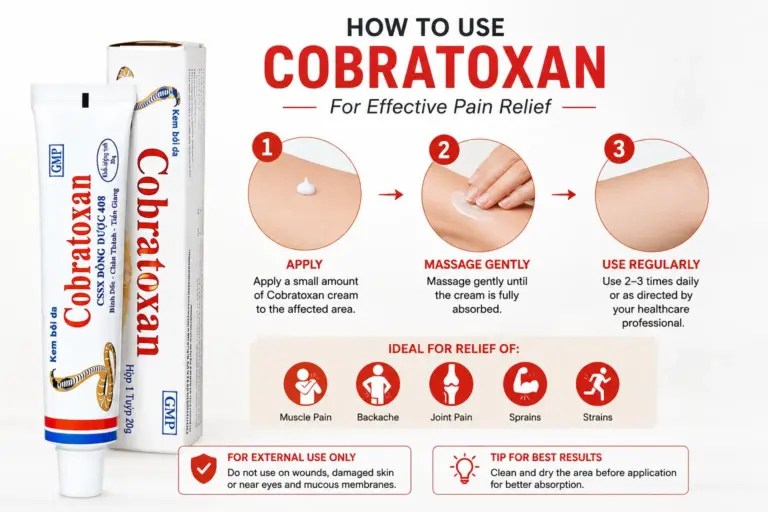
Gentle massage may help distribute the cream over the intended area.
Relief is usually temporary and should not be described as a cure.
What Is Cobratoxan Cobra Venom Cream?
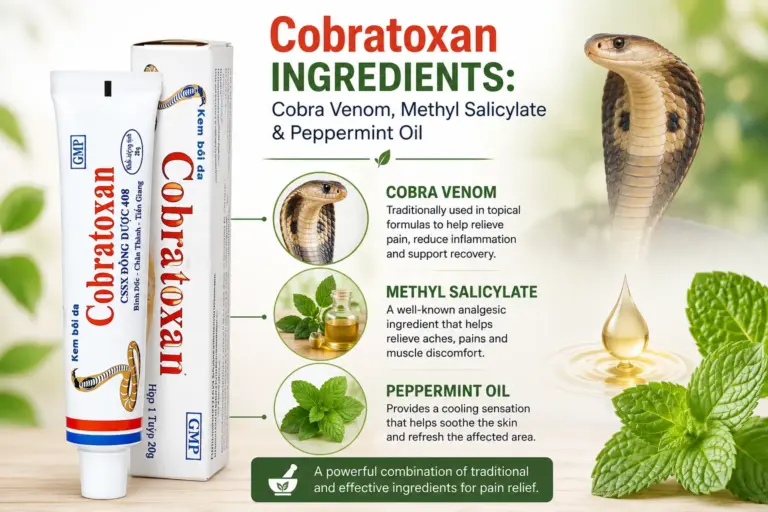
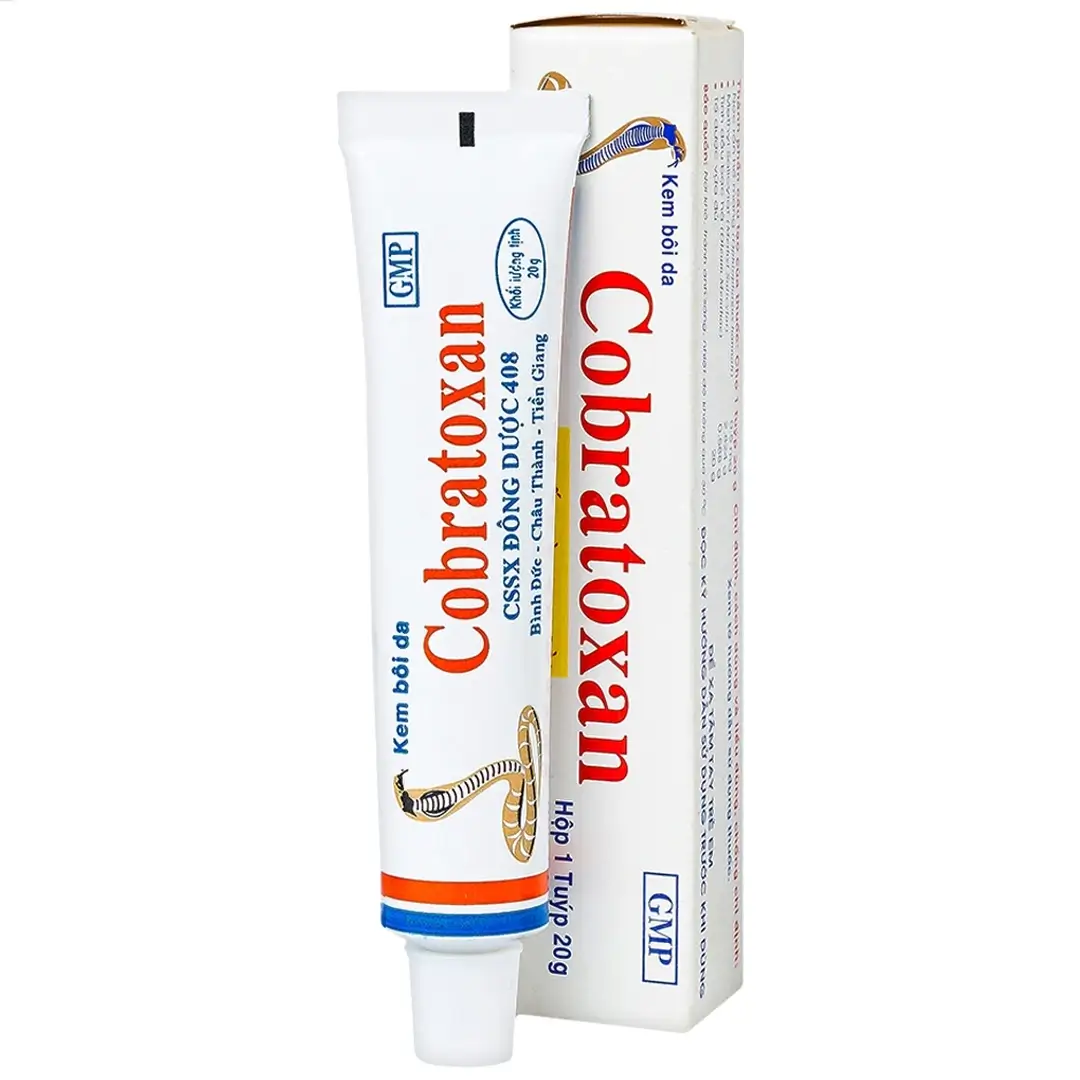
Cobratoxan is a manufactured topical cream for external use. According to the current listed formula, each 20g tube contains methyl salicylate, peppermint oil, a very small measured quantity of cobra venom and other formulation ingredients sufficient to form the finished cream.
Methyl salicylate is associated with the formula’s warming and counterirritant properties, while peppermint oil contributes its recognizable aroma and cooling sensation.
Although cobra venom is the product’s best-known ingredient, the practical effect of the cream should be understood as the result of its complete formulation—not as proof that cobra venom alone is responsible for any perceived relief.
For realistic expectations and limitations, read the Cobratoxan Benefits Guide . For application steps, see How to Use Cobratoxan Cream .
For broader product questions beyond venom science, visit the Complete Cobratoxan FAQ .
What Type of Discomfort Is Cobratoxan Used For?
According to the product information, Cobratoxan is intended for the temporary symptomatic relief of localized muscle and joint discomfort. Common application areas may include the knees, wrists, ankles, elbows, neck, shoulders and lower back.
It may also be used for localized muscular discomfort following excessive physical activity, provided the skin is intact and the application is consistent with the current product directions.
Cobratoxan should not be presented as a cure. It does not cure arthritis, repair joint damage, reverse nerve disease or replace appropriate assessment and treatment for an injury.
Safety and Precautions
A topical product can still cause irritation or unwanted reactions. Always follow the current packaging, label and supplied instructions.
Basic application precautions
- Apply only to suitable, intact skin.
- Avoid the eyes, mouth and mucous membranes.
- Wash your hands after application.
- Use only the directed amount and frequency.
- Keep the tube out of the reach of children.
Do not apply to
- Open wounds, cuts or scratches
- Ulcers or infected skin
- Markedly inflamed or severely irritated skin
- The breast area while breastfeeding
- Sensitive areas not specified by the instructions
Avoid unadvised combinations
- Do not cover with a tight or airtight dressing.
- Do not add direct heat over the treated area.
- Do not combine it with another balm, patch, cream or medicated oil on the same area without professional advice.
Stop use when necessary
- Severe or persistent burning develops
- A rash, swelling or blistering appears
- Symptoms become worse after application
- Another unusual reaction occurs
People who are pregnant or breastfeeding, sensitive to salicylates, using other medicines or managing an ongoing health condition should consult a doctor or pharmacist before use.
When Should Pain Be Checked by a Doctor?
Temporary topical relief should not delay medical evaluation when pain may have a more serious cause.
Can Snake Venom Replace Conventional Pain Treatment?
No. Scientific interest in venom-derived compounds does not make snake venom a general replacement for established pain treatment.
Appropriate treatment depends on the cause of the pain. Management may involve rest, adjusted activity, physical therapy, rehabilitation, oral or topical medicines, treatment of inflammation or other medical interventions.
A topical cream may temporarily reduce localized symptoms, but recurring pain should be investigated rather than repeatedly covered up without determining its cause.
Snake Venom and Pain Research FAQ
These questions focus specifically on venom science, pain signalling and the difference between raw venom, isolated compounds and finished topical products.
Can snake venom reduce pain?
Certain isolated snake-venom compounds have demonstrated analgesic or antinociceptive effects in laboratory and animal research. These findings cannot be generalized to untreated venom or every commercial venom-containing product.
How might venom compounds affect pain signals?
Some compounds interact with ion channels, receptors and neurotransmitter systems involved in nerve signalling. The effect depends on the precise molecule, quantity and research conditions.
Is raw snake venom safe to apply directly?
No. Raw snake venom is dangerous and must never be handled, injected or applied as a home remedy. Scientific research uses isolated, controlled materials under specialist conditions.
Does research on isolated venom compounds prove that Cobratoxan works the same way?
No. Laboratory findings involving a purified venom molecule do not automatically establish the effect of a finished topical product. Cobratoxan must be considered as a complete formulation containing cobra venom, methyl salicylate, peppermint oil and supporting ingredients.
Why must raw venom and formulated products be treated differently?
Raw venom contains many active substances in uncontrolled proportions and can be toxic. A manufactured product uses measured ingredients, a defined formulation and specific directions for use.
Need broader Cobratoxan answers? Visit the Complete Cobratoxan FAQ for questions about ingredients, uses, benefits, application, safety, side effects, storage and buying.
Promising Science Requires Careful Interpretation
Snake venom contains biologically active molecules capable of interacting with important pain-signalling pathways. Research into selected, purified venom compounds may contribute to the development of future medicines.
However, raw venom remains hazardous, and findings involving an isolated experimental molecule do not automatically establish the effectiveness of a finished topical product.
Cobratoxan is a formulated external-use cream containing a very small quantity of cobra venom together with methyl salicylate, peppermint oil and supporting ingredients. It should be used only as directed for temporary symptomatic relief.